Model guide · 3rd generation (BP)
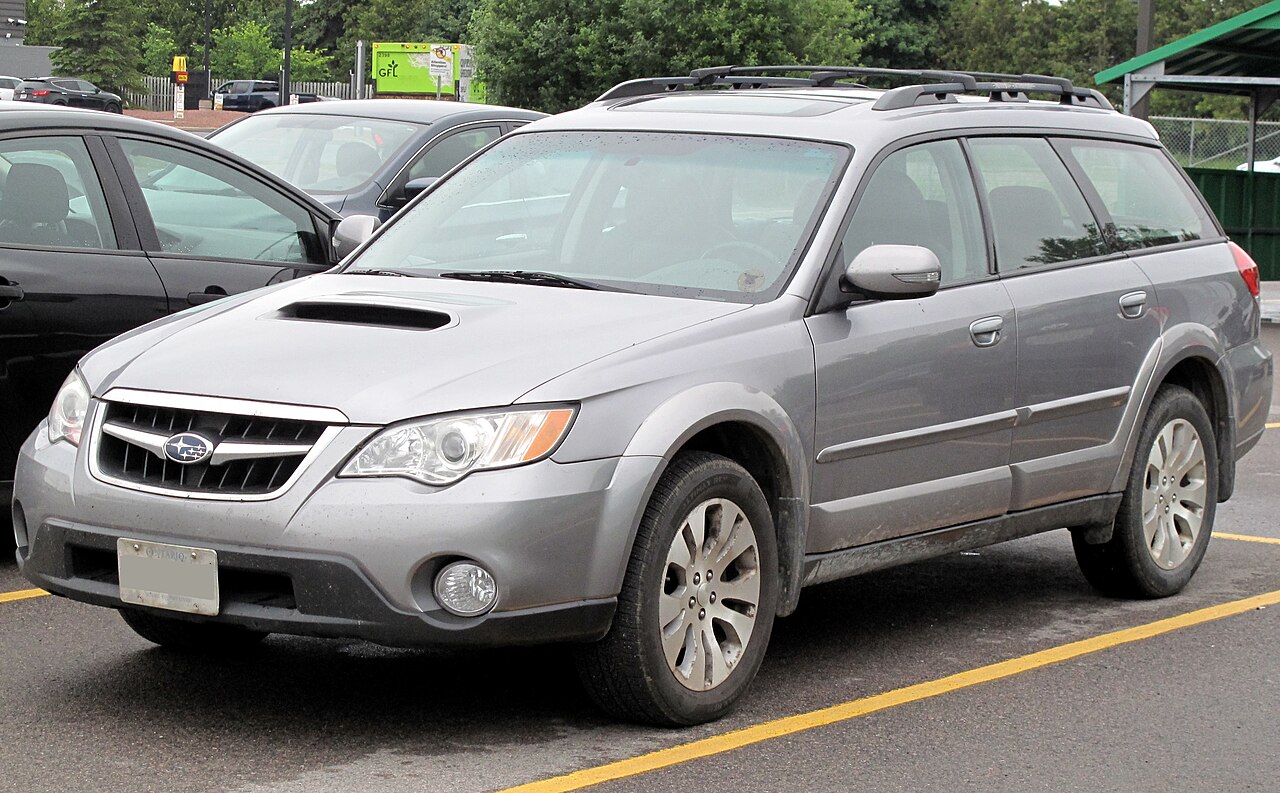
2005–2009 Subaru Outback
The 2005–2009 Outback is a Legacy-based wagon lifted for rough roads, with all-wheel drive on every car. Owners choose it for winter traction, a practical cargo area and a pick of four-cylinder, turbo or six-cylinder power.
8.4–8.7 in
Ground clearance, by version
168–250 hp
Horsepower, by engine
3 engines
2.5, 2.5 turbo or 3.0 six
5 seats
Seating
Engines and transmissions
Tap one to see only what applies to it.
Capability3
All-wheel drive on every Outback
Every 2005–2009 Outback has Symmetrical All-Wheel Drive. Manual cars split power 50/50 front to rear, while automatic 2.5XT and 3.0R models use Variable Torque Distribution.
2.5XT turbo power
This car has the 2.5XT's turbocharged, intercooled 2.5-liter, rated at 250 hp when it launched for 2005. EPA lists premium fuel for it, so plan on the higher grade at the pump.
3.0R six-cylinder with timing chains
This car has the 3.0-liter six-cylinder boxer with a 5-speed automatic, rated at 250 hp at launch. Its camshafts run on timing chains, so there is no belt to replace. EPA lists premium fuel.
Safety3
Side and curtain airbags standard
Front side airbags and side curtain airbags came standard, along with active front head restraints that move forward in a rear impact to help reduce whiplash.
Four-wheel disc brakes with ABS
Every Outback has four-wheel disc brakes with ABS and Electronic Brake-force Distribution, which balances braking front to rear when the car is loaded with people or cargo.
Vehicle Dynamics Control
This car's record lists stability control, which Subaru calls Vehicle Dynamics Control. It can trim engine power and brake single wheels to help keep the car on its line on slick roads.
Space1
Heated front seats
This car's record lists heated front seats. For 2005, Subaru fitted every Outback with four-stage seat heaters, a nod to the cold places these wagons tend to live.
Good to know1
Timing belt due at 105,000 miles
The 2.5-liter engines in the 2.5i and 2.5XT use a timing belt. Subaru's schedule calls for a new belt at 105,000 miles. Ask us whether this car's records show it has been done.
Specs are the manufacturer's figures for this generation. Equipment varies by trim and year, so ask us about anything that matters to you on a specific car.